

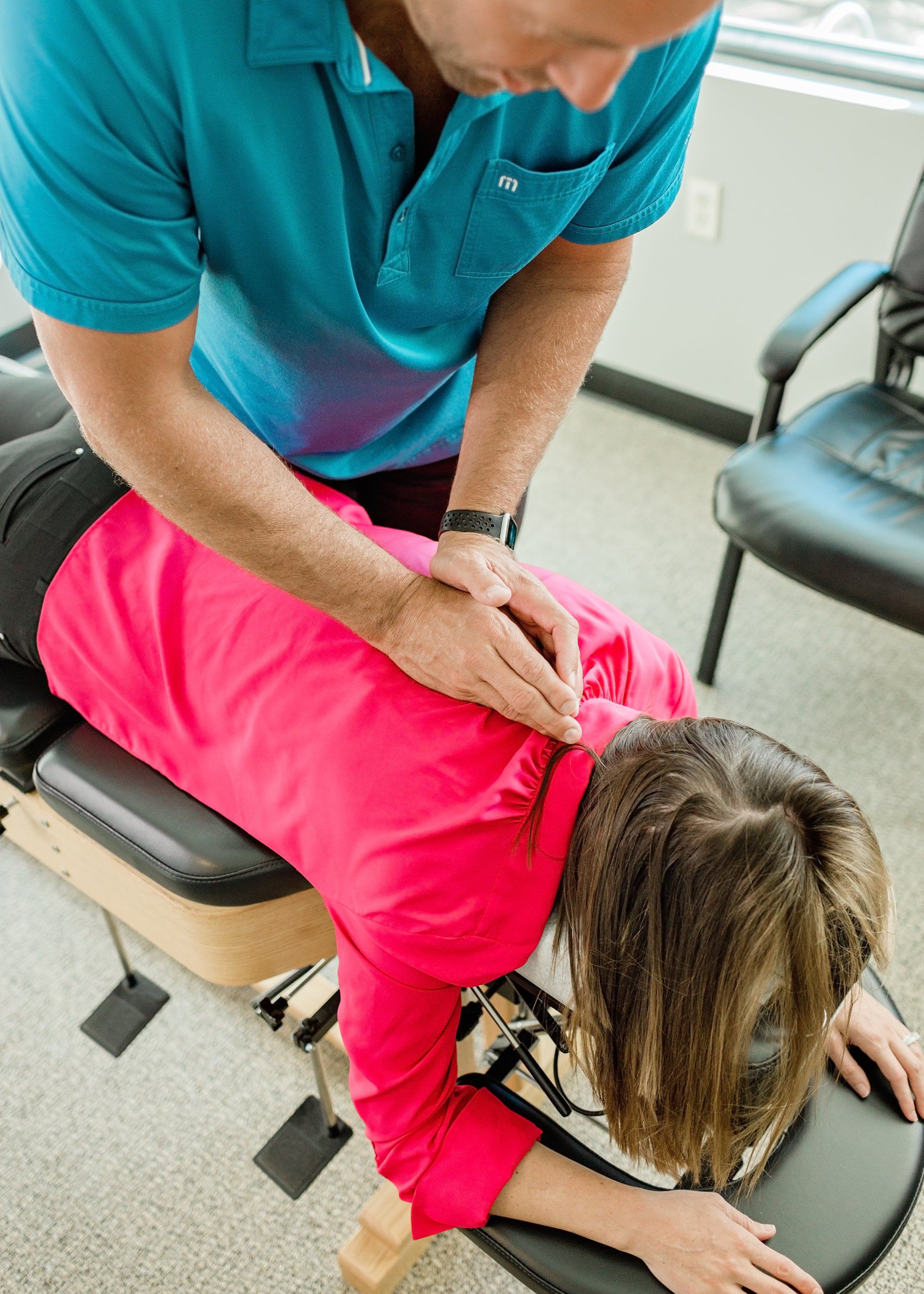

Dr. Coats believes in treating muscular and skeletal injuries with the most up-to-date researched methods including physical therapy along with soft tissue work, stretching and appropriate gentle manipulative therapy. His goal is to keep patients functioning optimally, decreasing pain, while increasing range-of-motion and function. We have 3 massage therapists on staff that provide specific deep tissue massage if this treatment is necessary in amelioration of symptoms.
- Spinal and extremity pain relief
- Headache relief
- Increased mobility and range of motion
- Decreased stiffness and muscular spasms
- Arthritic joint pain relief

![]()
Philosophy of Care
Dr. Coats believes in treating musculoskeletal injuries with the most up-to-date researched methods including physiotherapy modalities along with soft tissue work, stretching and appropriate gentle manipulative therapy. His goal is to keep patients functioning optimally, decreasing pain, while increasing range-of-motion and function. Upon figuring out the cause of the problem Dr. Coats may suggest ways the patient could avoid behaviors and postures in the future that brought the condition on in the first place. Thus, treating not only the symptoms, but the cause as well.
Education and Experience
High School:
Graduated 7th in class of 660 students while playing 3 sports. Also was a multi-publication All-American football player. Played in the inaugural All-America Bowl in Pennsylvania. Started dating his future wife Alicia his junior year in high school.
College:
Received a scholarship to play football at the University of Washington. Studied Psychology while having a Pre-Med focus. Began to do 1 of 6 Chiropractic internships while in school at Washington. Started 36 games as an offensive lineman while receiving All-Pac 10 honors academically and athletically all three years. Senior season received GTE/CoSIDA Academic District VIII All-American honors. Also Recipient of the John P. Angel Award, given to the team’s Offensive Lineman of the Year. Was named to the Sports illustrated, Playboy and Walter Camps All-American teams prior to senior year. Invited to the NFL scouting combine in Indianapolis, IN. Played in the 50th Senior Bowl All-Star Game in Mobile Alabama.
Personal:
Dr. Coats lives in the Cambrian area of San Jose with his wife Alicia and two children. He loves to workout and enjoys hiking, mountain biking, playing basketball and golf. Dr. Coats is the team doctor for the Los Gatos High School Boys Varsity Basketball team and conducts sports ready physicals for many of the athletes that participate in sports at Los Gatos High School.
| Athletic Preparation History and Physical | |
| Back In Action financial policy | |
| Back In Action Informed consent |
| Chiropractic Registration | |
| Back In Action Informed consent | |
| Back In Action financial policy | |
| Patient Health Questioneer | |
| Neck Index | |
| Back Index |
Chiropractic is the science, art & philosophy of locating & correcting vertebral misalignments through gentle, specific chiropractic adjustments thus allowing your body to function at it's optimum potential. Many patients also benefit from physiotherapy such as electronic muscle stimulation and moist heat. Myofascial release techniques (specific deep tissue massage) are used to free up adhesions in the muscle belly when indicated by exam. Professional athletes to weekend warriors can benefit from chiropractic care. Chiropractic care helps to restore range-of-motion and function to joints that may be locked-up or not moving properly. The athlete or the grandfather both will benefit from care at Back In ACTION!
A gentle, specific "thrust" delivered by hand or instrument. The purpose of the adjustment is to correct your spinal subluxation(s) thus removing the nerve interference in your body which helps to decrease muscle spasm and restore normal function.
No. Chiropractic adjustments feel great. I am confident that once you begin receiving your adjustments, you will begin to look forward to them. They will become one of the highlights of your week. When you allow the vertebrae in your spine to return to their proper position, this not only decreases muscle spasm, you will notice much less stress and tension as well.
Yes. Statistics prove that chiropractic care is one of the safest types of healthcare in the world. You only need to compare the malpractice premiums paid by chiropractors to those paid by medical doctors. Doctors of Chiropractic pay only a small fraction (approx. 1/20) of the price medical doctors pay in malpractice premiums. 250,000 people will die this year as a result of bad medicine, making this the third leading cause of death in the United States of America (The Journal of The American Medical Association, JAMA; Vol.284, July 26, 2000). Of the millions of people receiving chiropractic adjustments, each year, only a handful will even make a complaint.
Are Chiropractic Treatments Safe and Do They Hurt?
Chiropractic treatments are extremely safe for individuals of all ages - from infants to 100 year olds. Our treatments are safe because we only use natural and noninvasive methods of care. Research consistently shows that care from chiropractors is among the safest care available and is literally light years ahead of traditional medical care in terms of "safeness".
The treatments themselves are generally not painful. In fact, most patients look forward to their treatments as many experience instantaneous relief immediately afterwards. Individuals who present with moderate to severe pain may experience some minor discomfort for obvious reasons, however, care is always gentle, safe and noninvasive
Chiropractic spinal adjustments are extremely safe when performed by chiropractors. In fact, chiropractic adjustments are among the safest treatments for most back and neck problems. According to a 1993 Ontario Ministry of Health commissioned study,
"There is no clinical or case-control study that demonstrates or even implies that chiropractic spinal manipulation is unsafe in the treatment of low-back pain. Some medical treatments are equally safe, but others are unsafe and generate iatrogenic (doctor-induced) complications for low-back pain patients. Our reading of the literature suggests that chiropractic manipulation is safer than medical management of low-back pain."
Lead investigator of the study, Pran Manga, Ph.D., however, did warn that spinal adjustments performed by health care professionals other than qualified doctors of chiropractic were potentially harmful and less effective:
"Indeed, several existing medical therapies of low-back pain are generally contraindicated on the basis of the existing clinical trials. There is also some evidence in the literature to suggest that spinal manipulations are less safe and less effective when performed by nonchiropractic professionals."
On December 8, 1994, the Agency for Health Care Policy and Research (AHCPR) of the US Department of Health and Human Services released clinical practice guidelines for the management of acute low back pain. Their guidelines were developed after extensive study of the diagnostic and treatment methods used for acute low back pain. Their findings included:
- The risk of serious complications from lumbar spinal manipulation is rare
- Conservative treatment such as spinal manipulation should be pursued in most cases before considering surgical intervention
- Prescription drugs such as oral steroids, antidepressant medications and colchicine are not recommended for acute low back problems
The training and education endured by chiropractors is extremely thorough and demanding, similar to that of medical doctors with the exception of pharmacology and surgery.
Prior to entering chiropractic college, the aspiring chiropractor requires 2-4 years (depending on the college attended and the state one wishes to practice in) of premed undergraduate studies. Once completed, the student must next complete 4-5 academic years of studies at a chiropractic college. This includes extensive training in anatomy, physiology, pathology, neurology, radiology, differential diagnosis, chiropractic adjustive techniques, biomechanics , and other health-related studies.
In addition, prior to graduation each student must successfully complete several hundred clinical hours of "real" patient management in a clinical setting under professional supervision. Most chiropractic colleges also require students to partake in clinical externship programs which place them in actual chiropractic offices, further enhancing their clinical practice skills.
Near or soon after graduation, the new doctors of chiropractic must successfully complete rigorous National and State Board examinations prior to obtaining a license to practice chiropractic. Once licensed, most states require that chiropractors receive annual continuing education to ensure that a high level of competency is maintained.
That sound is not your spine "cracking" or "popping" like most people think. That sound is created by gas (in this case, nitrogen) rushing in to fill the partial vacuum created when the joints are slightly separated. Another example of this phenomenon would be the "pop" sound you hear when the cork is taken out of a champagne bottle. Not all chiropractic adjusting techniques produce this noise. In fact, some adjusting techniques use little force and thus produce no noise at all.
This question is frequently asked because people associate the "cracking" or "popping" of one's back or neck with a chiropractic adjustment. The two are not the same thing. If a person has a desire to "crack" his/her neck or back it is often because one area of their spine is fixated or jammed causing another area to move too much and "pop", sometimes by itself. It's the fixated or jammed area that needs to be properly adjusted by a chiropractor so that the other parts of the spine will not be hypermobile and noisy. When you "crack" your back you may be relieving the tension for a little while. Do you notice how it keeps coming back? That is because you are not giving yourself a specific chiropractic adjustment. The cause of the spinal tension, the fixated or jammed (subluxated) vertebrae, has not been corrected. Any person who makes a habit out of "cracking" or "popping" their back or neck needs to go to a Doctor of Chiropractic to have their spine checked. Even a chiropractor cannot adjust him/herself.
No. The extent to which you choose to benefit from your chiropractic care is ultimately up to you. Each & everyone of us is solely responsible for the quality of our health & well-being. However, we do strongly urge all practice members to consider lifetime, wellness chiropractic care. This is where the long-term, lasting benefits of care are enjoyed. Regular exercise & healthy eating habits are a lifestyle decision and so is lifetime, wellness chiropractic care.
Yes. Just because symptoms disappear, does not mean the vertebral misalignments or soft tissue adhesions are corrected. Most of the practice members seen in our office have spinal degeneration (decay) which has taken years to develop. The trauma of the birth process, slips, falls, accidents and countless other stresses over the course of your lifetime adversely affect the health of your spine. The longer you wait to have your spine checked by a chiropractor, the longer it will take to correct the fixated segments. However, how you choose to use chiropractic care is ultimately up to you. It has been our experience that those who stop care when they are "feeling fine" return with the same health challenge(s) which brought them to our office in the first place. When there is dysfunction pain is the last symptom noticed and the first to disappear. This discomfort goes away before your spine and surrounding soft tissues have had a chance to return to pre-injury status. On the other hand, those practice members who commit to long-term, wellness chiropractic care, find their health challenge(s) rarely return and they enjoy a higher quality of life & health.
Articles, tips, and facts to keep you in the best of health
Exercise Regularly: This does not have to be anything overly strenuous. Something as simple as a daily walk can make a huge difference.
Eat a Healthy Diet: Proper nutrients allow the body to repair itself easier
Maintain Good Posture: Are you sitting up straight as you read this?
Stretch Your Spine Before And After Sports: This will also help to loosen up the surrounding muscles.
Don't Overload Your Backpack Or Purse: Remember to carry it over both shoulders to balance the load (if possible).
Stretch Your Legs And Back After Each Hour Of Sitting: Whether in a car or at a desk, stretching regularly will help to keep you from tightening up or injuring yourself further.
Never Cradle The Phone Between Your Neck And Shoulder
Sleep On Your back Or Side, Not On Your Stomach: This helps to keep your spine in line and reduces the risk of hurting your neck while you sleep.
Invest In A Good Chair, Pillow And Mattress: When you think about the amount of time you use these things each day, it's worth it.
Have Regular Spinal Check-Ups: It's much easier to prevent a problem than to correct one.
Many avid golfers contort their bodies into oddly twisted postures, generating a great deal of torque. Couple this motion with a bent-over stance, repeat 120 times over three or four hours, add the fatigue that comes with several miles of walking, and you've got a good workout-and a recipe for potential lower-back trouble.
As America's love affair with the game continues to grow, the American Chiropractic Association (ACA) has advice on how to take a proactive approach that will prepare your body for many years of pain-free play.
"Most golfers go until they get hurt, then look for help," says Dr. David Stude, member of the ACA Sports Council and founding fellow of the National Golf Fitness Society. "Back pain is a warning sign that there is an underlying problem responsible for a symptom that will likely get worse. Doctors of chiropractic look for the cause of the symptom and help reduce the likelihood of future injury."
If you take the chiropractic approach, you're in good company. According to Dr. Stude, Tiger Woods says that lifting weights and visiting his chiropractor regularly have made him a better golfer. Dr. Stude and the ACA suggest these simple measures to help you avoid back pain or injury and improve your game:
- Purchase equipment that fits. Don't try to adapt your swing to the wrong clubs: A six-footer playing with irons designed for someone five inches shorter is begging for back trouble.
- For the women in golf: If you have "inherited" your husband's or significant other's golf clubs, they might be difficult for you to use. Not only are the clubs often too long, but the shaft is often not flexible enough for a woman's grip. Women typically play better with clubs that are composed of lighter, more flexible material, such as graphite.
- For the men in golf: It is a good idea to spend some extra time performing quality stretches-before and after your game-to increase your trunk flexibility. While men are traditionally stronger than women, they usually aren't as flexible. Men need to improve their flexibility to maintain a more even and consistent swing plane and thus improve the likelihood of more consistent performance.
- For senior golfers: If you show some signs of arthritis in the hands, consider a larger, more specialized grip for added safety and performance.
- For all golfers: For some, scores may not be as important as enjoying the social benefits of the game. Having clubs that are comfortable will increase the chances of playing for a long time without significant physical limitations.
- Take lessons. Learning proper swing technique is critical. At the end of the swing, you want to be standing up straight; the back should not be twisted.
- Wear orthotics. These custom-made shoe inserts support the arch, absorb shock, and increase coordination. "Studies show custom-made, flexible orthotics can improve the entire body's balance, stability and coordination, which translates into a smoother swing and reduced fatigue," Dr. Stude says. While the upper part of a shoe may score style points, what the foot rests on affects your game.
- Avoid metal spikes. They tear up greens and can increase stress on the back. Soft shoes or soft spikes allow for greater motion.
- Warm up before each round. "Stretching before and after 18 holes is the best way to reduce post-game stiffness and soreness," says Dr. Stude. Take a brisk walk to get blood flowing to the muscles; then do a set of stretches. To set up a stretching and/or exercise routine, see a doctor of chiropractic or golf pro who can evaluate your areas of tension and flexibility.
- Pull, don't carry, your golf bag. Carrying a heavy bag for 18 holes can cause the spine to shrink, leading to disk problems and nerve irritation. If you prefer to ride in a cart, alternate riding and walking every other hole-bouncing around in a cart can also be hard on the spine.
- Keep your entire body involved. Every third hole, take a few practice swings with the opposite hand to keep your muscles balanced and even out stress on the back.
- Drink lots of water. Dehydration causes early fatigue, leading you to compensate by adjusting your swing, thus increasing the risk of injury. Don't smoke or drink alcoholic beverages while golfing, as both cause loss of fluid.
- Take the "drop." One bad swing-striking a root or a rock with your club-can damage a wrist. If unsure whether you can get a clean swing, take the drop.
Check back periodically for more articles, tips and facts on back health.
Last updated: 10/30/08
If you have a question or comment please feel free to email me, call me or submit via our online form below. We are at the corner of Lark Ave and University Avenue. Next door to The Sandwich Maker Deli. Single story location with plenty of parking.
987 University Ave Suite 28
Los Gatos, CA 95032 Tel: 408.395.2424 (office) Fax: 408.395.2447 Email: |
![]() | |
| View Larger Map | Driving Directions | |


